(This biography is from a monthly letter from Abbaye St. Joseph de Clairval, Flavigny, France, and is used with permission. Their website, www.clairval.com, contains many other inspirational biographies as well as information on the monastery, how to receive their monthly letter, and the Ignation retreats which they offer.)
Israel, a young Jew, got along well at school with Stanislas, a young Christian. Invited to his friend's house, Israel saw a crucifix hanging on the wall. He had never seen one before. When he went home, he asked his family about this man hanging on a cross. They replied, 'This is something that concerns Christians, not us.' Much later, he read in the prophet Isaiah the songs of the servant of the Lord, in which is presented the purest and most innocent man, beaten, humiliated, and put to death for our sins. The nagging question then sprang to his mind: 'Isn't the crucified man I saw this servant of Yahweh?'
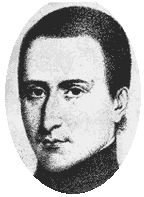
Young Israel Zoller was born on September 17, 1881, in Brody, in Galicia, now a region in southeast Poland, but at that time part of the Austro-Hungarian empire. He was the youngest of five children. Members of the Jewish faith, the family was relatively well-off, as the father was the owner of a silk factory in Lodz, then in Russian territory. In 1888, the Czar decided to nationalize every business owned by foreigners. Mr. Zoller's factory in Lodz was confiscated without financial compensation. The family's way of life was considerably reduced, and the eldest sons were forced to move away to look for work.
At the age of seven, Israel attended the Jewish primary school, where the children learned passages from the Bible by heart. But his taste for religious learning came primarily from his father. For her part, his mother taught him to help the needy. Moved by her neighbor's poverty, she redoubled her good works, appealing when necessary to the other ladies in her neighborhood, Jewish or Catholic. In the Brody area, there was no scorn or mistrust between Jews and Christians. A bond, in fact, 'spiritually ties the people of the New Covenant to Abraham's stock. Thus the Church of Christ acknowledges that, according to God's saving design, the beginnings of her faith and her election are found already among the Patriarchs, Moses and the prophets. She professes that all who believe in Christ???Abraham's sons according to faith???are included in the same Patriarch's call, and likewise that the salvation of the Church is mysteriously foreshadowed by the chosen people's exodus from the land of bondage. The Church, therefore, cannot forget that she received the revelation of the Old Testament through the people with whom God in His inexpressible mercy concluded the Ancient Covenant' (Vatican II, Nostra Aetate, 4).
In 1904, Israel left his family, whom he would never see again. His mother, who had always wished to see him become a rabbi, had just died. While giving lessons to provide for his family's needs, he studied philosophy at the University of Vienna, then at the University of Florence, where he completed his doctorate. At the same time, he pursued rabbinical studies. Named vice-rabbi of Trieste in 1913, which at that time was an Austrian port, he married Adele Litwak, a Galician Jew, from which union a daughter, Dora, was born. During the first World War, Israel was hounded by the Austrian police as an Italian partisan, because he had studied in that country. At the end of the conflict, Trieste was united with Italy, and Israel Zoller was named Chief Rabbi of the city.
Wasn't Jesus a Son of my people?
In 1917, he suffered the profound pain of losing his wife. At the time, he had a mystical experience???one afternoon, 'all of a sudden and without knowing why, as if I were in an ecstasy, I called upon the name of Jesus... I saw Him as in a large painting... I gazed at Him for a long time, without restlessness, feeling, rather, perfect serenity of mind... I said to myself, ???Wasn't Jesus a Son of my people?' ' Nothing premeditated, nothing prepared. It was a first quiet call from Christ.
Zoller married again in 1920, to Emma Majonica, who would give him a second daughter, Miriam. From 1918 to 1938, living all the while in Trieste, he taught Hebrew and ancient Semitic languages at the University of Padua. Surprisingly, he studied the New Testament as well as the Old Testament. In this way he became familiar with the person of Jesus Christ and His teaching. He could not keep himself from comparing the Old Testament to the New: 'In the Old Testament, Justice is carried out by one man towards another... We do good for good received; we do harm for harm we have suffered at the hands of another. Not to do injury for injury is, in a certain fashion, to fall short of justice.' What a contrast with the Gospel: Love your enemies... pray for them, or even Jesus' last words on the cross: Father, forgive them, for they know not what they are doing! 'All this stupefied me,' Zoller wrote. 'The New Testament is, in fact, an altogether new Testament.' And he clarified, 'Here a new earth, a new heaven begin... The rich who are attached to the earth are poor, and the poor who have been able to detach themselves from the earth are truly rich, because they possess a kingdom that belongs to the afflicted, to the silent, and to the persecuted, who have themselves never persecuted, but have only loved.' Little by little, Zoller discovered the bond that links the two Testaments. Indeed, 'God, the inspirer and author of both Testaments, wisely arranged that the New Testament be hidden in the Old and the Old be made manifest in the New. ... [T]he books of the Old Testament ... acquire and show forth their full meaning in the New Testament' (Vatican II, Dei Verbum, 16).
The Nazarene
In addition, Zoller noted with sadness that, among his co-religionists, 'love of the Law is often more important than the law of Love.' The petty details of rabbinical casuistry eclipsed the great commandment of the law revealed by God to Moses: You shall love the Lord, your God, with all your heart, and with all your soul... (Dt. 6:5). As a specialist in ancient languages, he discovered that the name 'Nazarene' first of all referred to the little town where Jesus lived during His first thirty years. But the name also meant that Jesus of Nazareth was the Nazir (the Consecrated One) announced by the prophet Isaiah: A shoot shall sprout from the stump of Jesse, and from his roots a bud (in Hebrew: nazer) shall blossom. The spirit of the Lord shall rest upon him (Is. 11:1-2a). He expounded on this discovery in his most significant work of the twenty years he spent in Trieste, The Nazarene (1938).
The striking agreement between the story of Christ's Passion in the Gospel and the Suffering Servant described by the prophet Isaiah eight centuries before His coming left Zoller convinced that this prophesy was fulfilled in Jesus: He was spurned and avoided by men, a man of suffering, accustomed to infirmity... we held him in no esteem. Yet it was our infirmities that he bore, our sufferings that he endured... He was pierced for our offenses, crushed for our sins...; by his stripes we were healed (Isaiah 53, 3-5). In addition, examining Jesus' declarations on His divinity led him to write, 'Christ is the Messiah; the Messiah is God; therefore Christ is God.' Zoller was intellectually convinced, but he did not yet have faith. Faith was a grace that he would receive seven years later.
The rapprochement between Mussolini and Hitler's Germany at the end of the 1930s brought with it anti-Semitic campaigns in Italy, particularly in areas close to borders with the Third Reich. In Trieste, where there were many Jews, a Catholic historian organized a series of anti-Semitic conferences. A large audience was expected. Zoller decided to intercede with a Jesuit, a friend of the speaker's. The religious arranged a meeting between the rabbi and the orator. With gentleness and kindness, Zoller exhorted his listener, in the name of Christian principles and especially in the name of the forgiveness that Jesus Christ granted on the Cross, to cancel his conferences. The professor raised the difficulty of his situation as an objection???everything had already been organized. The rabbi shrugged his shoulders and advised him only to read the Gospel, as he often did himself. He predicted, 'The time is near when we will become good friends.' The following Sunday, in front of a packed auditorium, the lecturer announced that a high-ranking Jew had enlightened his conscience. He no longer wanted to continue on the path he had strayed down until then, and canceled the scheduled conferences.
But already discriminatory laws had been enacted against the Jews. Israel Zoller Italianized his name to 'Zolli.' Nevertheless, he was soon stripped of his Italian nationality, but he was not particularly worried. In 1940, the Jewish community in Rome offered him the post of Chief Rabbi. He accepted the position, with the goal of protecting his brothers in the persecution that was anticipated, and of making peace among the divisions within the Jewish community, whose members he exhorted to set politics aside and turn their attention to prayer, teaching, and mutual aid. But this appeal met with almost no response.
A solidarity that saves
In September 1943, after the fall of Mussolini and the armistice signed by the king of Italy, Victor Emmanuel III, with the Americans, Hitler sent thirty German divisions to occupy northern and central Italy. Himmler, commander of the SS, determined that the time had come to apply the policy of extermination of the Jewish race in Italy. He ordered the head of the SS in Rome, Lieutenant Colonel Kappler, to gather all the Jews together, men and women, children and the elderly, for deportation to Germany. Lieutenant Colonel Kappler took advantage of the deportation order that he had received for extortion. He summoned the two men presiding over the Jewish community in Rome, and demanded they deliver 50 kilos of gold to him in twenty-four hours, or else all the men in the Jewish population in the city would be deported immediately. In fact, it was a matter of a list of three hundred hostages, at the top of which Zolli appeared. The next day, the Jewish community had been able to collect only 35 kilos of gold. They asked the Chief Rabbi to go to the Vatican to try to borrow what was missing. He succeeded in entering the Vatican, all the exits of which were monitored by the Gestapo, by a hidden door in the back of the City, and explained his request for a loan of 15 kilos of gold to Pius XII's Secretary of State, Cardinal Maglione. He gave his own person as a security. The prelate consulted with the Holy Father, then asked Zolli to return before one o'clock in the afternoon. But shortly thereafter, Zolli learned that the quantity of gold required had already been collected, thanks to contributions from priests and numerous Catholic organizations.
However, this was only a respite. The Chief Rabbi made every effort to convince the Jews of Rome to disperse to avoid deportation. Soon the German ambassador to the Holy See, von Weizs??cker, who was secretly hostile to Nazi policy, warned the Pope that Himmler had ordered the deportation of all Jews in Italy. Pius XII immediately ordered the Roman clergy to open their sanctuaries so as to receive the Jews who would come to hide there. Zolli, who had a price on his head, lived in hiding for the next nine months and, finally, with Christian friends of his daughter, Dora. He thus succeeded in escaping from the Gestapo. But despite the precautions taken, in the night of October 15-16, a thousand Roman Jews (out of about 8000) were arrested and deported. Most would not return.
'From now on you will follow Me'
On June 4, 1944, the city of Rome was liberated by the American forces. By government decree of September 21, 1944, Israel Zolli, who had been relieved of his duties seven months earlier by leaders of the Jewish community, became Chief Rabbi of Rome again. During the feast of Yom Kippur (the Day of Atonement) in October 1944, he presided over the prayers of Great Pardon in the synagogue in Rome. 'Suddenly,' he wrote, 'I saw, with the eyes of the mind, a large prairie, and standing in the middle of the green grass was Jesus, dressed in a white robe... At the sight of this, I felt a great interior peace, and, from the depths of my heart, I heard these words: 'You are here for the last time. From now on, you will follow Me.' I received them in the greatest serenity, and my heart immediately responded, 'As it shall be, so it must be.'... An hour later, after supper, in my room, my wife declared to me, 'Today, while you were standing before the Ark of the Torah, it seemed to me that the white figure of Jesus was laying His hands on you, as if He were blessing you.' I was stupefied... At that very moment, our younger daughter, Miriam, who had gone to her room and hadn't heard anything, called for me to tell me, 'You are in the middle of talking about Jesus Christ. You know, Papa, this evening I saw a big Jesus, all white, in a dream.' I wished them both a good night and, without feeling at all ill at ease, I continued to think about the extraordinary sequence of events.'
A few days later, the Chief Rabbi relinquished his duties, and went to find a priest in order to complete his instruction in the truths of the faith. On February 13, 1945, Archbishop Traglia conferred the sacrament of Baptism on Israel Zolli, who chose 'Eugenio' as his Christian name, in gratitude to Pope Pius XII for his decisive action on behalf of the Jews during the war. Zolli's wife, Emma, received Baptism with her husband, and added the name 'Maria' to her first name. Their daughter Miriam would follow her parents after a year of personal reflection. Eugenio Zolli's baptism was the result of a long spiritual evolution: 'This event in my soul was like the arrival of a beloved guest. I began only to hear the voice of Christ expressed most clearly and most strongly in the Gospels. In my soul, God did not reveal Himself at all by means of tempest or fire, but through a gentle murmur... I became aware of a God Whom I loved, a God Who wants to be loved, and who Himself loves... The convert, like the man miraculously cured, is the object (the one who receives) and not the subject (the perpetrator) of the miracle. It is false to speak of someone who has converted as if he has acted from personal initiative. No one says of the miraculously cured that he has cured himself, but that he has been cured. We must say the same of the convert.'
All men and women are His children
Zolli was often asked if he had converted out of gratitude towards Pope Pius XII. He always answered in the negative, adding, however: 'You could say of the reign of Pius XII that it was inspired by the words of the prophet Isaiah: 'Peace is harmony, peace is salvation for those who are near as for those who are far, I wish to heal all' (cf. Is. 57:19). The Catholic Church loves all souls. She suffers with all and for all. She waits with love for all her children on Peter's holy threshold, and her children are all mankind... There is no place of suffering that Pius XII's spirit of love did not reach... In the course of history, no hero commanded such an army. No military force was more fighting, none was more fought against, none was more heroic than that led by Pius XII in the name of Christian charity.' According to the Jewish historian Pinchas Lapide, the Catholic Church, through its charitable action, was able to save from certain death approximately 850,000 Jews living in areas occupied by the Third Reich (Cf. Pius XII and the Second World War, by Father Pierre Blet S.J., Paulist Press, 1999).
The night of his Baptism, Zolli did not even have enough to eat dinner. Archbishop Traglia gave him 50 lira. At the age of sixty-five, Zolli found himself suddenly confronted with grave financial problems, starting with that of supporting his family. Up until that time, he had always lived from his fees as a Rabbi and a professor. He accepted this new situation with the greatest detachment: 'I am asking for the water of Baptism and nothing else. I am poor and I will live poor. I have trust in Providence.' The news of the Chief Rabbi of Rome being baptized launched a chorus of slanders. He was accused, among other calumnies, of having apostatized out of self-interest. It was easy for him to answer: 'The Jews who convert today, as in Saint Paul's time, have everything to lose in terms of material life, and have everything to gain in the life of grace.' He responded to the reproach of treason with indignation: 'The God of Jesus Christ, of Paul, is He not the same God of Abraham, Isaac, and Jacob?'
In our time, certain Catholics think it is pointless for a Jew to convert to become Christian. This opinion is contradicted by the teaching of the Second Vatican Council: 'Christ, present to us in His Body, which is the Church, is the one Mediator and the unique way of salvation. In explicit terms He Himself affirmed the necessity of faith and baptism (cf. Mk 16:16) and thereby affirmed also the necessity of the Church, for through baptism as through a door men enter the Church. Whosoever, therefore, knowing that the Catholic Church was made necessary by Christ, would refuse to enter or to remain in it, could not be saved' (Vatican II, Lumen Gentium, 14).
At three o'clock in the afternoon, just like Jesus
Through the Holy Father's intervention, Eugenio Zolli was named a professor at the Pontifical Biblical Institute. In October 1946, he entered the Third Order of Saint Francis, the distinguishing feature of which is evangelical poverty practiced by lay people in the world. Zolli, a faithful parishioner at Stella Matutina, discreetly attended talks on the Gospel given by his parish priest. During Christmas 1955, he himself gave a conference on the announcement of the Redeemer in the Old Testament. But in January 1956, he came down with pneumonia. His wife Emma was also sick and elderly. Their younger daughter, Miriam, who was married and had given birth to a little girl, Maura Brigida, stayed at her father's bedside in this final illness. A week before his death, Eugenio confided to a nun who was caring for him, 'I will die the first Friday of the month, at three o'clock in the afternoon, just like Our Lord.' On Friday, March 2, in the morning, he received Holy Communion. Having fallen into a coma at noon, at three o'clock in the afternoon Eugenio Zolli committed his soul to God. He had written at the end of his memoirs: 'We can trust in nothing save the mercy of God, save the compassion of Christ, Whom humanity put to death because it did not know how to live in Him. We can rely on nothing but the intercession of Her whose Heart was pierced through by the lance that pierced Her Son's side.'
Through his spiritual journey, Eugenio Zolli shows the continuity between the old Covenant and the New:
"'Do not think that I have come to abolish the law and the prophets. I have come, not to abolish them, but to fulfill them' Jesus had said (Mt. 5:17). God has visited his people. He has fulfilled the promise he made to Abraham and his descendents. He acted far beyond all expectation -- He has sent His own 'beloved Son.' ... 'In many and various ways God spoke of old to our fathers by the prophets, but in these last days he has spoken to us by a Son' (Heb. 1:1-2). Christ, the Son of God made man, is the Father's one, perfect, and unsurpassable Word. In Him He has said everything; there will be no other word than this one... 'In giving us His Son, His only Word,' wrote Saint John of the Cross, 'He has no more to say... Any person questioning God or desiring some vision or revelation would be guilty not only of foolish behavior but also of offending Him, by not fixing his eyes entirely upon Christ and by living with the desire for some other novelty' ' (Catechism of the Catholic Church, nos. 422 and 65).
For Zolli, the demands that this truth brought with it were not easy to implement. At the end of his life, he said, 'Those of you who are born into the Catholic faith do not realize the opportunity you have, to have received the grace of Christ since your childhood. But those who, like me, have come to the threshold of faith after long work continued over the course of many years, appreciate the grandeur of the gift of Faith and feel all the joy there is to be Christian.'
Let us thank God for the gift of Faith that He has granted us undeservedly. Let us preserve this treasure through a holy life, and let us pray that all men and women might know the Messiah, believe in Him, and obtain eternal Life.
Bibliography: Judith Cabaud: Eugenio Zolli,
Prophet of a New World (de Guibert, Paris 2000).